




#02. YouthDecide Ambassadors! Meet Claudia Larumbe
After taking part in the Regional Workshops, some young participants were invited to continue their journey with YouthDecide 2040. The initiative was created by WP3 leader Jeanne Perreul, Participatory Projects Manager at Missions Publiques, to keep young people actively involved in the project while preparing for the next stage: the National Workshops held across Europe in April and May 2026.
As volunteers, the Ambassadors supported the process in different ways: they helped review translated materials, spread the word about the workshops, reach new participants and, in some cases, support facilitators during the assemblies.
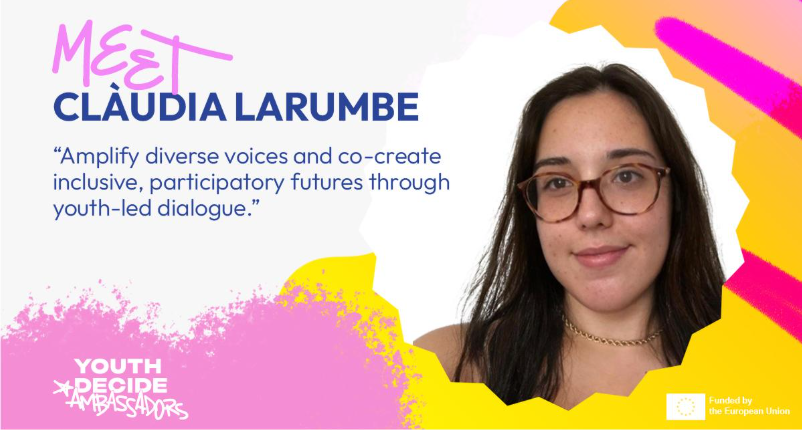
Today, let’s meet Clàudia Larumbe Serra! Clàudia has a background in International Relations and Gender Studies and works as a researcher with experience in policy, social media strategy and democratic engagement. Based in Barcelona, she is passionate about intersectional feminism and youth participation. As a YouthDecide 2040 Ambassador, she works to make democracy more inclusive and future-ready.
YouthDecide 2040. Can you tell us your first memory of democracy?
Clàudia Larumbe. I was seven years old, my nonna (she hated being called grandma), took me to Madrid as a birthday trip, a yearly tradition I’m still very thankful for. We went to the Museo de Historia de Madrid, where there was an expo on the civil war and the fascist dictatorship that followed. I turned to my grandma and asked, “the ones with their fist in the air, those are the good guys, right?” and she had a laughing fit in the middle of a very serious museum. That same year, I went with my parents to various protests against the government’s infrafinancing and neglect of Renfe in Catalonia. Not much has changed since then. Back then I didn’t understand the politics, the understanding came later (when I had to take the train myself).
YouthDecide 2040. You helped make the Spanish open call for the National Workshops more multilingual by translating several documents into Catalan. From your experience, why does language matter when trying to reach and involve young people in democratic participation processes?
Clàudia Larumbe. For me, Catalan is my mother tongue, the language I think in, dream in, and instinctively reach for when something matters. That’s precisely why it matters so much in democracy: when institutions only speak to you in someone else’s language, the implicit message is that your way of experiencing the world is secondary, that democracy was designed with someone else in mind. When a message arrives in a language that isn’t yours, especially one that has historically been imposed over your own, it doesn’t feel like an invitation. It feels like a reminder of who the process was really built for. Catalan is not a minority language, it’s a language that has been actively suppressed, pushed to the margins by institutional power for decades. When democratic processes are conducted exclusively in the dominant language, they risk reproducing that same logic, even unintentionally, so it was an honor for me to be able to facilitate the translation.
YouthDecide 2040. Recruitment and participation processes often assume that everyone can access the same information in the same way. What language or communication barriers do you notice, and what should institutions do better to reach more diverse young people?
Clàudia Larumbe. Institutional communication tends to be written in a register that assumes a certain level of formal education, dense, bureaucratic and it that feels alienating if you didn’t grow up navigating that world. Then there are the structural barriers: processes that assume stable internet access, flexible schedules, or the cultural confidence to walk into a formal setting and speak up. Democracy also means being present in the spaces young people already occupy, community centres, social media, informal networks, rather than expecting them to find an official website. It means working with trusted intermediaries: youth workers, community organisations, peers, people who already have relationships and credibility in those communities. It also means accepting that diversity of voice requires diversity of format. Not everyone expresses themselves well in a written survey or a formal plenary session. Some people think best in conversation, in their own language, in a familiar setting. Democratic processes that only recognise one mode of participation will keep hearing from the same people.
YouthDecide 2040. With your background in International Relations and Gender Studies, how do you think feminism can help us understand the future of democracy?
Clàudia Larumbe. For me, it makes no sense to talk about feminism without an intersectional look. Women’s experiences are not homogeneous: gender interacts with other axes such as race, social class, origin, disability, sexuality or administrative situation. Therefore, a democracy that wants to be truly inclusive cannot be limited to guaranteeing the formal representation of women; it must also take into account the inequalities that affect different groups simultaneously.
Clàudia Larumbe. Feminism as a framework for thinking about democracy – it reminds us that political participation depends not only on the right to vote or stand for election, but also on the material and social conditions that allow people to participate as equals. Who has time to get involved in public life? Who is listening? Who is constantly out of the decision-making spaces? It is not just a question of adding more women to institutions, but of understanding different forms of inequality, how they condition democratic participation, and to correct them so everyone can have their say.
YouthDecide 2040. Many young people are growing up in a context of political polarisation, misinformation and distrust. From your perspective, what kind of democratic spaces do we need to create so young people can speak, disagree and still build something together?
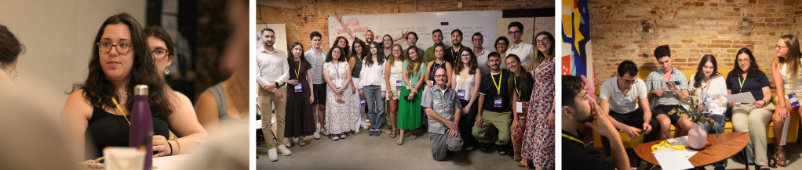
Clàudia during the Southern Europe Regional Workshop in Barcelona, July 2025
Clàudia Larumbe. I think one of the biggest challenges democracies face today is ensuring that we young people are not only included in political discussions, but are genuinely empowered to shape them. Usually youth participation is treated as symbolic only, but the thing is that young people are often at the forefront of social and political change! We bring new perspectives, challenge established assumptions, and are deeply affected by decisions whose consequences we will live with for decades. Opportunities for participation should not be limited to those who already have access to political networks, higher education, or social privilege. Democracies become stronger when we feel like our voices matter, when we can influence outcomes, and that political participation is something we do with others rather than something that is done for us.
YouthDecide 2040. Looking back at your experience in YouthDecide 2040, what do you think young people can bring to democratic engagement that institutions often fail to see? And what would a more inclusive, future-ready democracy look like to you?
Clàudia Larumbe. One of the main lessons I take away is that we young people bring much more to democratic engagement than institutions often recognise. We are frequently perceived as disengaged, inexperienced, or lacking the knowledge required to contribute meaningfully to public debates. However, what institutions often fail to see is that we offer perspectives that are shaped by the realities of the world we are living in. The rising cost of living, difficulties finding stable and well-paid jobs, high housing costs, climate concerns, constant technological change, and shifting social expectations. These experiences give us a unique understanding of the challenges that makes it easy for us to question assumptions and to imagine alternatives beyond what we have right now.