




#01. Our democracies are not failing: they are failing to deliver, by Michael J. Bernstein
Europeans are not turning away from democracy itself, but from systems that fail to meet expectations of fairness, public services, and meeting daily needs.
By Michael J. Bernstein
One doesn’t have to go far today in the US, Europe, or UK to hear lamentations about the state of democracy. Increasing swings in anti-democratic movements get pinned to a range of factors— on young people excluded from political participation, immigration, globalization and offshoring, replacement of human labor by technology, general economic marginalization. At the same time, research also shows how large companies with undue market influence, often tied to illegal monopoly positions, actively undermine democracy through lobbying, political capture, tax avoidance, and general misbehavior, like exploiting the environment or degrading human rights, all in the name of profit maximization.
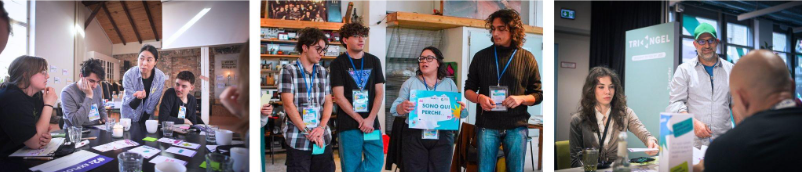
Giulio continued his journey at the National Workshop held in Lecce, Italy.
The research behind these observations is sophisticated, and the explanations robust. But all the talk about complexity glosses over a more straightforward question: are Europeans getting what they expect from their governments? This question differentiates between what people expect of democracies (normative expectations) and what they think about how a democracy is performing (evaluative dimensions). To the extent one’s expectations of a democracy exceed an evaluation of one’s experience, we would anticipate dissatisfaction. Which shouldn’t be surprising, right? One goes out to a nice meal, with high expectations of delicious food, and if it comes out burnt, soggy or bland, it’s going to be disappointing. “Why am I paying for this when I could make better at home?”
Researchers from the Polish Academy of Sciences, Radek Markowski and Piotr Zagórski, have provided a robust, evidence-based account of just how potentially troubling a gap between expectations and performance can be when it comes to satisfaction with European democracies. Drawing on a 10-year comparative study with data from the European Social Survey module on democracy, their findings suggest that persistent gaps in performance on key democratic dimensions — protection of minority rights, socially beneficial redistribution, institutional protections of elections and rule of law — represent potent sources of democratic dissatisfaction and potential instability in society among young and old alike.
The consequences of such dissatisfaction are not abstract. In the UK, researchers studied the effect of decline in public services in the UK. Since 2013, the UK National Health Service (NHS) closed or merged some 3000 facilities, of which 1700 were general practitioners, representing a 25% decline in what is a vital point for UK citizens to interact with government public services. The authors found this erosion of public service could be tied to increasing support for populist right-wing parties often at odds with democratic values. When austerity measures undermine public service provision, the decline creates direct grievances with political and governing bodies, creating openings for inflammatory anti-democratic parties to gain power by blaming immigrants or out-of-touch elites.
What too often goes unsaid or forgotten is, as Markowski and Zagorski concluded,”dissatisfaction with democracy often reflects unmet expectations rather than rejection of democratic principles. Citizens may remain strongly committed to democracy while simultaneously expressing dissatisfaction with how democratic systems perform” (p. 52). Just because one has a disappointing meal at a restaurant doesn’t mean one plans to give up eating.
Rather than engaging anti-democratic parties on the merits of their arguments, or shying away from confrontation, Markowski and Zagorski’s research points to another, far more satisfying route to safeguarding democracies: delivering improvements for people and fighting to do this every day.
In his first hundred days in office, New York Mayor Zohran Mamdani demonstrated a deep understanding and appreciation of this principle. On top of assuming control for all city operations, he held numerous Rental Ripoff hearings on dangerous conditions landlords refuse to fix while charging ever higher rents. He also pledged to fill 100,000 potholes across New York in 100 days, something one might appreciate if having ever felt one’s brain rattle in one’s skull on a taxi ride from the airport. Other efforts have focused on taking down sidewalk sheds, an eyesore and impediment to movement in numerous neighbourhoods; improving public bathrooms and sewers; and pioneering a historic extension of free childcare for two-year-olds in New York, a big deal in the U.S., even if something people in European social democracies might take for granted.
Take another case in the EU. Access to affordable housing and adequate access to public services are becoming an increasingly worrying issues for young people across Europe, especially in urban areas, where it is linked to tourism pressure, digital nomadism and speculative purchase of properties by wealthy individuals and investment funds. In Spain in particular, housing has become central to the political debate and is closely connected to wider feelings of disaffection, particularly among younger generations. Housing scarcity, especially the limited stock of public and protected housing, is increasingly being used by far-right actors to fuel anti-democratic and xenophobic narratives. In Barcelona, rental prices have skyrocketed, rental availabilities have radically declined, and much of the building stock is aged out of regulations for thermal insulation, making them a climate liability. Following a 2025 constitutional court ruling affirming Barcelona’s right to prioritize resident housing, the city has taken strong steps to curtail the contribution of short term housing rentals to the crisis. Meanwhile, at the national level, President Pedro Sánchez is pushing forward a 12-part plan to advance affordable housing in the country.
There is no shortage of fronts to safeguard the democracies of Europe, the US and the UK. As Markowski and Zagórski elaborated in another report, democracies face social and cultural vulnerabilities; threats from economic inequality and elite capture of politics; and consequent decay of democratic institutions including the media, judicial independence and elections. Each of these threats point to viable countermeasures to reinforce a social fabric where democratic practices are valued. One example includes shoring up policies that safeguard social, economic, and environmental justice. Another boils down to enforcing market competition which, in turn, connects to a third step: safeguarding democratic institutions like equality before the law, free and fair elections, and accountability through a robust civil society.
But it could all start with, “strengthening the capacity of democratic institutions to understand and meet citizens’ expectations,” Markowski and Zagórski explained, and then delivering results. Seen in this light, far-right turns present an opportunity for democratic leaders to improve quality of life for citizens as a means and ends to safeguarding democracy – something that could bring everyone to the table.
ABOUT
Michael J. Bernstein is a senior scientist at the Austrian Institute of Technology, where he leads a group on societal futures at the Center for Innovation Systems and Polcy. His project-based work spans international, trans-disciplinary collaborations on responsible innovation funded by the EU, US, and Japan. He currently coordinates the European Commission funded Horizon Europe project YouthDecide 2040 on futures of EU democracy and leads the participatory work package in RE4GREEN on climate and environmental research ethics.